Pages

Wednesday, August 6, 2014

Santo Domingo Bay and Sweet Pea Cove

The white sand beach of Santo Domingo with the entrance to Bahía de Concepción on the opposite shore
Heading out of Escondido, we decided to get up to Bahía de Concepción, another 70+ nm to the north. That meant a night sail and we had good winds for it. We set the sails and got another good port tack that would take us out for a bit at about 5.5 knots. As we passed near Loreto, we heard the familiar zzzzinnng on the ugly stick fishing pole hanging off the back. Mike turned us into the wind and did a heave to maneuver to slow us down. 

We have become very efficient at heaving to, and it has come in quite handy on many occasions. When we do this, we are folding the genoa jib sail in the front sort of unto itself. So if we are on a port tack, which means the wind is coming over the port (or left) side of the boat, our genoa and our main are both on the starboard side to catch the wind. By turning to a starboard tack, but keeping the genoa set for a port tack, the wind is now blowing on the outside of the sail cloth, but the main is now on a starboard tack. This creates two competing forces and as a result, voila! the boat slows down to a near stop and you can do what you need to do. This can be a necessary emergency tactic for strong storm winds, but luckily, we have only used it when we need to be taking care of something that is difficult to do if we are underway. 

OK, back to our little fishy. So we start to reel it in. Everyone is excited. Is that a yellow color on the tail?! What is it? Yellow Fin? Dorado? And, inevitably....it's a skip jack. I feel that we are cursed to only pull in skip jack and at this point I am starting to wonder if the only break to this curse is to actually eat one. We actually soaked our last ones in milk, as recommended by the local fisherman, but ended up having to give it to someone else. They did later eat it and said it was good. Still skeptical. I still remember the taste from that skip jack in 2000, and I am not in any hurry to repeat that culinary experience. We pull it in as we debate whether to keep it. The kids are voting to keep, of course they do not have to clean it. Mike and I are looking at each other like, are you going to be the first to say, let's throw it back? As we are waiting for the other to say what we are both thinking, this damn thing is flopping all over, spraying the inside of the cockpit with blood. Ugghh!  I finally break, "Throw it out!" We do and it swims off on its merry way. Meanwhile, it has managed to spray every inch of the cockpit. It seriously looks like a Chicago slaughterhouse onboard. Blech! That's it! From now on, skip jacks are strictly Catch and Release!

We release the sails from the heave to and continue on. 

The night was uneventful, but had great wind for the majority that scooted us along at about 5 knots or so. There were a few hours where we needed to motor, but the batteries can always use a top off and fresh water can be made at the same time.

Morning dawns and we can see the land ahead that marks the tip of the entry to the bay. We look at the guide and see that there is a nice beach on the north of the tip called Santo Domingo and we decide to head into that. Wind takes us nearly all the way, but as we approach, we bring down the sails and start the engine to allow for more maneuverability. There are two sails and one motor vessel already in the bay, but it is a large area so we swing around and approach from the northwest to avoid the shallow shoals. After a bit of shuffling around, we find a spot at about 18 feet that allows us to just barely tuck back far enough to get some protection from winds that whip around the eastern point of the bay. The water is crystal clear. You can see everything along the bottom and the kids immediately jump in to retrieve clam shells they can spot down below.
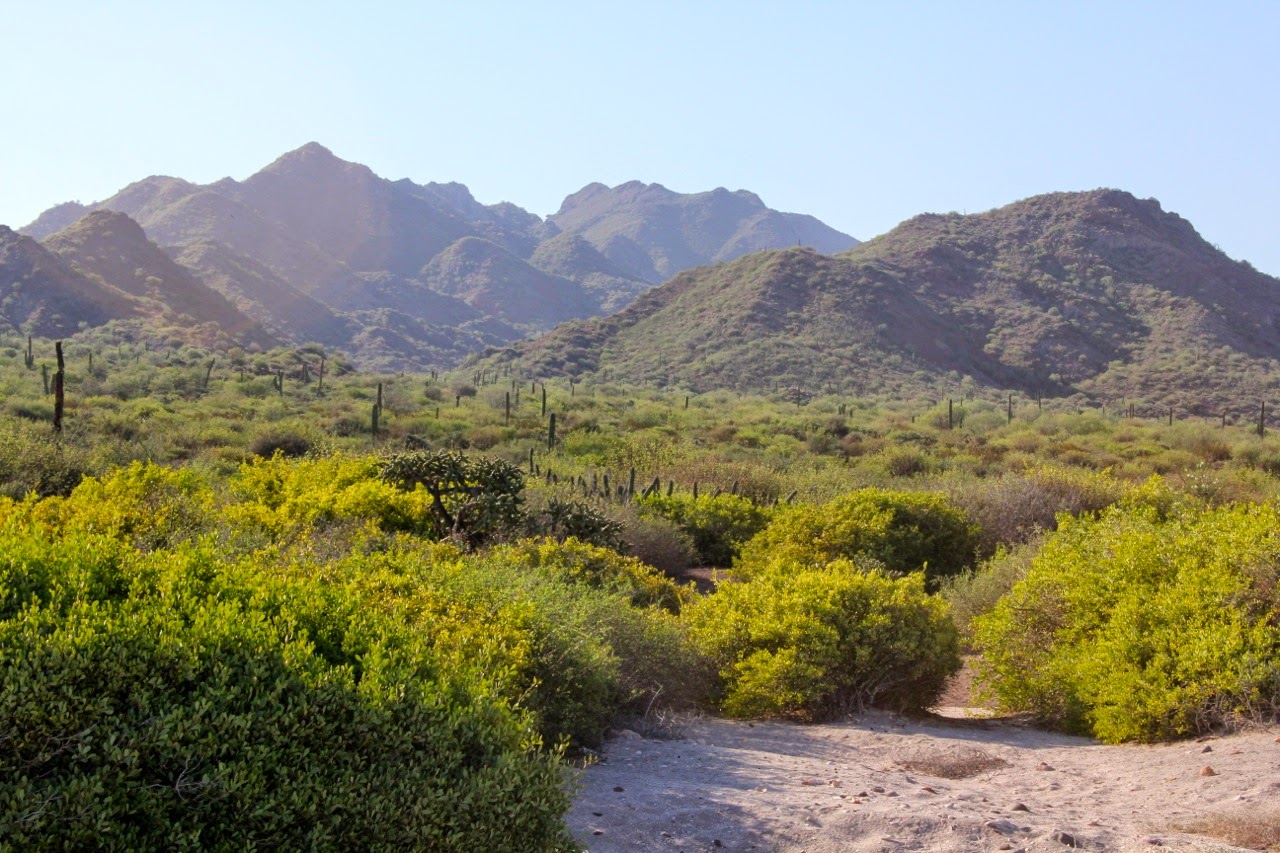
Sonoran vistas surrounding Santo Domingo

The land has received a lot of rain and the desert plants are lush, fragrant and green. Lots of critters abound and Mike captured a nice snap of a most particularly curious fellow below.

A young Desert Jack Rabbit with those lovely big ears

Bay to ourselves with Mangas in background
The following morning, the other boats had pulled out and we had the cove to ourselves.
We took the dinghy on to shore with all of the snorkel gear. We found lots of long narrow rock shelves just under the water that were teeming with little fish. Floating over the top with a snorkel, just letting the current carry you over the small rocks and sea weed patches and then further over the large boulders with some reef life is so peaceful. There were many wrasses with their bright pinks and blues and yellows and many starfish. The reef area itself is not very healthy, but it is hard to tell if it is declining or coming back. I saw a bright parrot fish scrapping off nibbles from the rocks and many triggerfish and bass. We could have easily floated out there all day.


Snorkling crew in the crystal clear blue


Mike decided it was high time to get out his speargun and bring home some dinner. He headed out over the reef area and quickly came up with a good 12-inch grunt fish. Dinner! We sent him back for another and he rose again with a 10-inch grunt and all smiles. Nice to know we can bring home fresh fish when the ugly stick fails us. 

Mike with the smaller of his two grunts getting ready to filet

He is anxious to get out again to spear the following morning. Unfortunately, that night, as Mike was securing the deck for the night, I hear a rain of obscenities from topside. Mike has ripped open his pinky toe on a latch setup for the line bags. 

I bring him down and take a look. He has ripped it right along the seam at the inside base of the toe where it meets the foot. I quickly grab our first aid kit and get out the hydrogen peroxide, antibiotic gel and bandages. As I lift the toe up to look underneath, I see a gaping hole and much of the inner workings of the toe. Blech. I am debating whether we need to seek medical care for stitches and, meanwhile, telling Mike it doesn't look too bad, it's fine. Luckily, he can't see it from his vantage point. 

There is blood, but not a lot because the way the pinky toe naturally curls, it keeps the gash closed. I pour the hydrogen peroxide and squirt in copious amounts of antibiotics. Then I try the steri-strips, but the gel and the position of the wound won't allow them to adhere. I wrap it with gauze and tape it with water repellent tape and call it good. Due to its location and the fact that the skin gap is naturally closed by the toe's position, we decide that stitches are not going to do any better. Being that it is the foot, we start him on a course of antibiotics just for good measure. He will be out of the water now for at least a week.

As gorgeous as it is in the bay, it is hot. "Biloxi Blues" keeps playing in my mind with Matthew Broderick marching and bemoaning, "This is hot, this is like Africa hot". We need to stay undercover from about 9 AM until about 6 PM because the heat and the cloudless sky makes for a very uncomfortable day. Mornings and evenings are awesome, but we are beginning to wonder if we can take the oppressive heat for the next 2 months before it breaks. Unfortunately, Mike cannot even get a break with a swim since he is now boat bound. 

We had planned to get a bit of provisions at the tienda in Bahía de Concepción, but learn that provisions are scarce there outside of the cruising season. We decide to head north to Santa Rosalia for the provisions.

It should only take us a day to get up to Sweet Pea Cove just outside of Santa Rosalia where we will anchor. Wind is great for half the day and then nothing in the afternoon and we are forced to motor. Coming along the eastern side of Isla San Marcos we look to its eastern shore line to see if we can spot an anchorage, but quickly decide to stick to the original plan and motor over to the western side and Sweet Pea Cove. The flying fish are also active. We saw hundreds of these on our recent crossing and we really enjoy watching them  - although we do not enjoy when they actually make it on deck. They go incredible distances, hundreds of yards flying along the surface. They look like little bright silver metallic birds skimming along the swells. As we near the tip of the turn and are about to make a west heading - zzzzziiiinng! The ugly stick sounds off and we have something on the line. 

Mike quickly gets not the reel and starts to bring it in. "What is it?!"  The kids yell. Skip Jack, I think. It suddenly flies out of the water and lands on its side. OMG! Is that what we think it is? A Dorado! Woohoo! Finally. 

Dorado! (aka Mahi-Mahi)

We pull him in and he is absolutely beautiful. We know that he will provide some fresh fish meals for a few days to come. We quickly put him in the cooler and the kids keep checking to watch his colors change. The fish is no longer alive and its scales go completely grey, then Reid adds water to cool it down and it turns green again. This keeps the kids entertained for most of the afternoon. 

Fish secure, we head around the north tip of the island to Sweet Pea Cove. Already in the cove are two boats that had been at Santo Domingo and we quickly chat it up with them on the radio to announce our big catch. They both had luck with Dorado that day as well, so everyone is well stocked.

After setting anchor at 30 feet, Mike gets down to the business of cleaning the fish. Once the kids are past the initial wonder and excitement induced by the cleaning, they join me on deck and watch the incredible water show in the cove. 

Future fish cleaners getting a lesson

This cove is just a flurry of activity. There are schools of large fish being chased to the surface and jumping out to avoid, who knows what, everywhere you look. There are at least 30 or so small rays slapping the surface all over the cove. Together these activities create a cacophony of sounds that reverberate off of the cove walls. It is really loud. Not sure what is lurking below and driving all the activity?  The kids and I decide to skip the evening swim. 

Once the filets are ready, it is already quite late, so I soak them in lime and tequila and prepare them for the next day. Instead, we eat a quick pasta meal and call it a day. We throw all of the cushions on deck and get our sleeping arrangements organized. It is about 11 PM by this time and the activity on the water has not abated. In fact, it seems to be getting even more frenzied. Even larger fish are flying out of the water avoiding something or some things. The rays are slapping harder, or probably just seems that way. And then, there is another sound. In the darkness, it sounds like a diver breaking up through the surface and taking deep breaths of air before heading down again. It is a disconcerting noise, until I realize that the noise is coming from sea lions who have come to feed. Everyone else is asleep, but I cannot help staying awake, looking at the stars and listening to all of the crazy and spectacular sounds. 


Tuesday, August 5, 2014

Back on the Baja

Lightening on the horizon
Our first night anchor after crossing was in San Evaristo. This small fishing village has a great cove that is protected from most winds and swells, except those coming from the east. With the southerly blows we were having, we knew it would be fine. San Evaristo also has a couple of small tiendas and I was dying for a Mexican Coca-cola. I rarely drink soda in the states, but there is something special about Mexican cokes. Maybe it is the old fashioned cane sugar rather than corn fructose? Maybe just a different recipe altogether, but whatever the reason, they are especially refreshing. Yum. 

We pulled in and immediately got the dinghy out and headed for the beach and the mini-market beyond. Luckily, she did have a few sodas, but since it was way past the usual cruiser season, she didn't have much else. No worries, coke in hands, we trotted off back down to the beach. 

It was hot, really hot. The water is so warm right now that it is feels good to be in it, but coming out feels like you never actually got in. Thankfully we did have some wind in the evening, which helped. The cove is really beautiful this time of year. It might be hot, but they are getting rain, so everything is popping up green.  We tried our hand at fishing, but only those damn puffers seemed to chase the hook. 

I was really looking forward to staying put for a few days after the 3 night passage, but the following day, the winds started to pick up from the north and Mike wanted to take advantage of it and get some good sailing in, so we headed out about 11 AM.  And, he was right, it made for wonderful sailing. We headed off on a port tack taking us straight towards Isla San Jose across the channel. We were soon doing 8 knots over water with very minimal heeling as we held a beam reach point of sail. We tacked a few times to make it out of the channel and made good time, but a storm was building behind us and we needed to seek an anchorage before nightfall. We headed for Timbabichi. We had anchored here before in the winter, but our trajectory on the plotter had been lost, so we headed in with an eye on the depth finder. We must of come over a sandbar, because it got as shallow as 10 feet and freaked me out a bit. After maneuvering around a bit, however, we found a nice 20 ft drop spot and let her go. 

We fished for a while and had a great front row seat to a spectacular lightening show to the south around San Evaristo, where we had just left. We felt really lucky not to be in the middle of that. At 65 feet, our mast is typically the tallest in every anchorage. Not sure that comes into play with lightening, but we feel very vulnerable as a result. A lightening strike on a boat is not good. 

Honeymoon Cove


The following day, we headed to Puerto Escondido, the aptly named Hidden Port to the north. They had fuel, which we needed, and hopefully a stocked tienda.


Heading in is interesting, if you have never been in before, because it really is quite hidden. The first place you hit is the Waiting Room with the breakwater to the port just beyond. A deep cove, this area has mooring balls that apparently are private. Not sure how that works. The small breakwater entrance into the main port, and where we find fuel, is only about 10 feet deep, so we need to be cautious. We cruised through the Waiting Room to see if we could find an anchorage, but at 65 feet, we did not feel comfortable putting out that much rode in such a small area. Instead, we headed across the channel to Honeymoon cove on the Isla Danzante.

We found a great little spot and had the cove all to ourselves. As we dropped anchor, the rays came out in full force, slapping the waters surface as they jump in and out. Have yet to find a definitive reason for this behavior in my research, but, if I had to guess, it would appear that they do this slapping on top of schools of small fish. Do they stun them with the slapping? The slapping resonated on the canyon making for loud cracks throughout the evening. We put up our tent, which covers most of the cockpit and the deck to the mast, and then placed all of the cushions and pillows up top for sleeping. It was still too hot to try to sleep below. 

It was a beautiful evening with thousands of stars. We were able to view the Hubble telescope as it glided its way across the sky. We also caught Mars and Saturn as well as a number of constellations we were still not familiar with. 

In the morning, we had some protection from the early sunrise from the cove walls to the east. It made for a very pleasant morning and we looked forward to hanging out in the cove for a few days...and then...

At about 9 AM, we saw a bee. Now the standard rule around here is to make sure to kill any single bees. These are reportedly scouts and when you see one, that means others are sure to follow. Unable to get the little sucker, we quickly dried up all water along the sink, made sure there were no standing dishes and were not very concerned. About 30 minutes later, there were 4 bees. Keira, as per normal, immediately got stung - poor thing. She is a magnet for bees and jellyfish. An hour later there were hundreds. We sent the kids down below with a fly-swatter and all the portholes closed, while Mike and I pulled up anchor as fast as we could and scaddadled! The tent was still up, but we had to get out of there. I was dancing at the helm, trying not to get stung and Mike stepped on a bee and got stung in the foot. We pulled up anchor fast and motored out to the channel as quickly as possible. When we finally got a safe distance, we opened up the companionway and let the kids out. Coming out of our cabin, Reid looked like a little warrior with his neck dripping blood where he had been stung and our little fly shaped fly-swatter in his hand, minus its antenna and 3 plastic legs from one side. He was exhilarated to tell us that his last count was 28 slain! The girls, Keira's sting behind her, were unscathed. The galley area looked like a war zone. Lots of little black carcasses scattered everywhere. 

Despite their casualties, the bees had definitely won and we decided that we needed to bite the bullet and head into the port. 

Not knowing if the breakwater channel was deep enough, we pulled into the Waiting Room and pulled up an unoccupied mooring ball. The thought being we would dinghy in and check depth before scooting Mangas through. 

We grabbed a ball and got hitched without a problem, and then the radio came alive. 
1st Cruiser: "C_, C_, M_" 
2nd Cruiser: "This is C_, go ahead M_" 
1st: "Channel 17"
2nd: "17" (We turn to 17, believing this exchange and our arrival was no coincidence) 
1st: "Hey, wanted to let you know that someone has taken one of your spots" 
2nd: "Oh, OK, thanks for looking out for me"

Good grief. I quickly got on 16... "This is a call out to any cruisers in the waiting room, Mangas, Mangas" a moment later...
1st Cruiser: "Mangas, this M_, how about 17?" 
Us: "17" 
1st:" Hello, are you who just pulled in and moored?" (Like they did not know...:) ) 
Us: "Yep, we are hoping to get information about depth before we go in for fuel" (Nice as pie voice as I can muster)
1st: "Oh, I see, yea, it is high tide you can go in no problem" 
Us: "OK, great, thanks for the information, Mangas back to 16" 
1st: "Back to 16". 

If you are not familiar with VHF, that is pretty much the syntax for all communication. But, the context of this particular exchange is pretty funny. They were really put out when they first called back to us, but after they realized that we were not out to squatter on someone's ball, they relaxed and actually got friendly. Who are these people? How does one get a private mooring ball in Mexico in a cove in the middle of nowhere? When half of them are unoccupied, why do they care if someone uses one? Good grief...it is our common refrain in these situations. 

We got into the fuel dock with no issue, unfortunately, we found that the tienda and restaurant were no longer here due to the higher rates they were faced with last May by the government run Fonatur, which manages this port. So, with fuel no longer an issue, we continue north towards Bahia Concepcion. 


Wednesday, July 30, 2014

At sea again at last!

Trying to catch the green spark
We left Mazatlan early in the day to hit the high tide and to beat a storm front coming into the area. As we navigated the narrow channel down to the fuel dock, the winds began to pick up, but we couldn't avoid getting fuel. 

We pulled in without incident, letting the wind push us to the dock and we fueled up, eyeing the breakwater area, wondering how much more wind would pick up before we could depart. Once fueled, we headed out, struggling a bit against a much stronger headwind that was coming in at about 14 knots and we headed out the breakwater. 

It was a beautiful morning, the clouds from the coast extended out just enough to provide us with nice shade cover for the first part of the morning. We got about 2 miles off coast before setting sails, hoping to take advantage of the headwind and set a port tack to take us northwest along the coastline. We were headed to the east coast of the Baja, where exactly, would be determined by the wind direction since we wanted to motor as little as possible. 

The first day saw great sailing at a calm speed of 5 knots with out needing to tack as we kept our heading throughout the day. The sun rose and the clouds broke and we were getting baked by mid-day. I kept eyeing the water beyond the sugar scoop and wondering if we could stop long enough to jump in. We were in 2500 feet of water at that point and I have to admit, that I still get a bit squeamish about swimming in water that deep. But, we kept going and tried to stay in as much shade on deck as we could...which, without a bimini, was not much. 

About this time, Mike had to take on the task of de-pickling (is that a word?) the water maker and getting some water made. After 3 hours of flushing and checking filters and taking a boost pump apart, we still could not get the water maker to come up to pressure and start making water for us. It had an incredible amount of air in the system, but there was something else wrong. I quickly did a calculation of how much bottled water, juice and boxed milk we had on board to figure what our options were as far as continuing or heading back to Mazatlan. We put Reid at the helm and Mike and I went through the entire system together and were able to finally get her going. Thank goodness! When it is 100 degrees out and you are baking, you really appreciate the importance of having a water maker at sea. 

The stress of that behind us, we got temperature relief in the evening and preceded on our way. Unfortunately, we had no wind at that point and had to motor sail along at 3.5 knots while we made water. 

When the sun came up in the morning, I was on duty at the helm and found that the Booby that had perched on our bow the night before was still there hanging out with us. 

A little friend riding along on the very calm seas

My view to port in the early morning hour with the moon getting ready to set

My view to starboard at the same moment as we continued northwest skirting the mainland about 12 miles off coast

Day two was much better with no water maker issues. Unfortunately, we also had no wind. We tried light sailing off and on. Mangas does very well in light wind. We can generally get 3 to 4 knots off of a 6 knot wind. But on this day, it seemed that every time we saw the wind meter kick up above 5, it would drop just a soon as we pulled out the jib sail. 

Later in the afternoon, after the brutal sun finally crossed and we got some relief, we had a really magical time at sea. We had no view of any land either to the east or the Baja to the west. It was calm as we motor sailed and we set the autopilot and got everyone on deck towards the bow to watch the sunset that was dead ahead. With the speakers out playing Roger Clyne and the Peacemakers, we listened to "Buffalo" and searched for the elusive green spark of the setting sun over water. 

The best seat in the house
We had a great dinner of beef shish kabobs on the grill and turned the Sirius to 70's on 7 for a very mellow, very special evening. We have seen no other boats since leaving Mazatlan and it feels like we have the world's oceans just to ourselves.

On night three, we did finally catch that green spark. It was the first one any of us had been able to see. The following morning we saw land as we were coming in just north of La Paz. Still no real winds and yet we had very choppy waves all the way in. I was on duty with everyone else sleeping below when I saw our first boat as a La Paz ferry came barreling down on our position. I really do not think he saw us, and at 2 knots of speed, which is all we could muster in the extreme chop, I had no way to out maneuver him. The only thing I could do was turn a beam to him and show him our broadside. 


Another stowaway
The turn seemed to work and he moved his course, only slightly. He passed us .3 nm to starboard according to the radar. The closest we have ever passed another vessel at sea. 

The wind then caught up with the chop and we set sails for a good 1 hour run towards Isla San Jose, before it died on us. But, the wind direction had finally changed to allow us a downwind course, the first since we left Mazatlan. We decided this was the best time as any to finally break out the gennaker sail. A big parachute sail, the gennaker balloons out from the bow and can really shine in light down winds. After double checking that all the lines were set correctly, we hoisted the sail sock and let her fly. She is truly a thing of beauty and, even better, she provided great shade!

Hard to get a good shot of the gennaker while on the boat - but she is big!

Keira doing school work in the nice shade


Finally, back to our beloved Baja. We anchored in San Evaristo and enjoyed a restful night sleep after 3 nights and 4 days of travel and over 250 nm from La Paz.


Tuesday, July 29, 2014

Spanish School in Tepoztlan (Finale)

Kids with their Spanish teacher, Vicki at the Borda Gardens in Cuernavaca
OK, so we traveled from Mazatlan to Guadalajara and then on to Cuernavaca in the state of Morelos. We arrived a little bus terminal 45 minutes earlier than expected because our driver drove like a bat out of hell and I was just thankful that I couldn't see through the windshield to the road ahead from our vantage point. 

The last leg of the bus ride skirted the Southwest corner of Mexico city and, I have to say, it was stunning. Very modern architecture and cool building facades. Mike and I were both very impressed to see LED billboards that were on the street level and had not been vandalized in any way. They would not have stood a chance in downtown Phoenix. 

Since we arrived so early, we had to wait for our contact from the school to arrive. We must have looked like gypsies. There were no seats left open, so we collapsed on the floor of the terminal with our duffel bags, long hair and wrinkled clothes and just stretched out. After the pickup time came and went, Mike asked how we would get in touch with them? No idea. No wi-fi, no phones, no choice but to just wait. 

Not long after, one of our teachers, Vicki arrived, introduced herself and shuffled us out to a taxi. One or two taxi's she asked in Spanish? We said two, to which she shook her head and said, no, one will work. So three adults (including the taxi driver) and three kids squished our way into a 4 seater taxi and started off on the 45 minute drive to Tepoztlan. 

When we left Mazatlan, it was 95 degrees with 90% humidity. Yuck. In Tepozatlan, it was mid-60's and we were literally freezing.

School grounds at Experencia in Tepoztlan

The kitchen shack
I had found the school through online searches. We needed a school that could provide structure for the kids as well as us and where we could all be housed. Most of the schools have home stays available, but it is difficult to accommodate a family of 5. Experencia was able to provide us with two rooms on the property and separate classes for the kids and me and Mike. 

The property was beautiful but very "rustic", as Mike would say. The kids room had a bathroom, but the shower didn't work. "It will be fixed mañana..." It never got fixed during our 3-week stay. Mike and I were in a room without a bathroom. There were bathrooms down a small hill, but it usually meant a trip in the rain to get to them at night. 

The kids met local kids and starting playing every afternoon with them after classes.


We were at the school during the World Cup and it was really fun to watch the games and cheer on Mexico and the US. We would frequently make trips to the Mercado in Tepoztlan to find some satellite tv, beer, appetizers and a crowd to enjoy the game with.

Unfortunately, all of us had contracted whooping cough from a family in Barre de Navidad that had just come down from the states. Luckily, we had the right antibiotics to fight any secondary infection, but we all sounded horrible for about 8 weeks. That coupled with the dampness and constant rain and mud, made for a challenging 3 weeks. Mike also had a horrible allergic reaction to the insides of the rooms. As a result, we had to get a cot moved outside to a space that had a ceiling but not much else. Meanwhile, the kids room sprung a few leaks in the ceiling after all of the rain, so I moved them into our room. Cozy! None of that was terrible, but the small black scorpions that we kept killing in the bedroom was a bit much. Scorpion fatalities in Western Mexico is a real thing and the state of Morelos reports 13,000 stings on average each year. Nice. 

But, that is always how it goes, isn't it? Beautiful surroundings, but there are always challenges. The kids fared very well through it all, no complaints and we were really proud of them. They are up for anything and very adaptable, which I am thankful for. 

The town of Tepoztlan itself is supposed to be one of the places of magical vortex, like Sedona, if you are familiar with that sort of thing. There are quite a few older American expat hippies or hipiteca's (as the local's call them) that have retired here to enjoy the easy going nature of the town, the beauty of the surrounding hillsides and the magical vibe. (OK, I could easily be a hipiteca in my old age :) ) 

We learned a lot of Spanish, of course, but in addition to that, we saw some great sites and adopted some new favorite things. 

Our first new favorite thing is Jamica agua fresca. Hibiscus flowers are soaked overnight in water and then the resulting juice concentrate is added to sugar water for a refreshing drink. We now make our own on the boat.

Dried flowers that you can buy in bulk here, or in packages from your local Mexican food store in the US
Soaking in water overnight (don't boil like it recommends) to make the concentrate

Our other favorite thing is banana leaf wrapped tamales, for which we got great instruction and learned a lot of good techniques to make perfect masa for the tamale.

Cutting the banana leafs to the right size for the tamales

Heating the leafs on the stove to make them pliable for wrapping

Mike mixing the masa with the pork fat for the tamale lining

Making little masa balls that will be used for each tamale

Assembly is masa, covered with the boiled chicken and red sauce then wrapped and steamed. Yum!
Nopales or prickly pear pads are also a new add to our normal grocery shop. We loved them diced up with eggs, or on cheese quesadillas. 
Nopal field in Tepoztlan


Finally, we found a panque de elite (little cornbread muffin loaves) in town that was made from organic corn, flour-less and just the most divine little morsels of sweet goodness you could imagine. I have yet to find a recipe that is an equivalent, but I am working on it!

We also took many side trips to Cuernavaca and to the Palace of Cortez, the Cathedral and other colonial era sites. 
Whenever we took the bus to Cuernavaca, there was always a musician or two who would come on board to play for tips. Which was a nice distraction, given the ride took an hour. The musicians were all quite good as well!


View from the Palace of Cortez to the fortress Cathedral, built in the 16th century

The manmade water feature at the the Borda Gardens, the summer residence of the Emperor Maximilian
Back in Tepoztlan, no visit to the area would be complete without a hike up to the Tepozteco, an Aztec pyramid constructed around the 14th century. It is small in comparison to other temples with only 3 tiers and being about 24 feet high or so. But the hike and view are quite spectacular.  

How many stairs did you say there were?


View from the top - very green and very blue sky. The girls are enjoying the view and that's our own pirate there on the left side of the photo. 

Breaking into our room after forgetting our keys - good thing Pinky is still so tiny

Finally, on our last day, we were treated to a local musician who came in to sing with us and teach us the lyrics of famous Mexican songs. I will have to add pics later that are on Mike's phone, but we had a great time. Who knew that La Cucaracha was the name of Pancho Villa's car?

Well, that about wraps up the highlights of our Spanish school adventure. We did learn a lot of Spanish and it has come in very handy since we left. We are trying hard to keep it up and to keep learning.  I know that the kids will keep great memories of the friends they made and hopefully, the Spanish will stay with them too.


Spanish School in Tepoztlan (Part 2)

At 1.5 million people, the city of Guadalajara is the same size as Phoenix, Arizona by comparison. The surrounding suburb cities, bring the metro area to a population of 5 million. Even though quite large, the city itself feels like it is made up of numerous smaller unique neighborhoods and towns and traversing through it was painless. We went to a very popular area downtown to explore the Cathedral and Hospicio Cabañas and  although it was a Sunday, with many families out and about, it did not feel at all crowded.

Walking towards the Hospicio Cabañas, which previously served many purposes over the centuries, but is now a museum
The Hospicio Cabañas started its life in 1760 when the Catholic Church commissioned its construction and use as a hospital and home for the needy. It is a huge complex comprising of a main building with a large park area in the center and numerous 
courtyards with main wings to the sides.


Right now it has an exhibit by Eduardo Sarabia. His works at this particular exhibit focus on the drug subculture of Mexico. He uses multiple mediums and some are quite elaborate (such as his videos and costume work), while others have a folk art feel with primitive drawings and themes.  I think that coming from the US, the sensibility is that we are all against the drug trade given its violence and corruption. But, it was interesting to see Sarabia's work where he mixes facts regarding that violence and corruption with the mythos that a younger Mexican society has attributed to the drug cartels and their leaders who are as flamboyant as they are cruel. Sarabia does not appear to condemn this culture, but he does shine a light on the hypocrisy of the system, such as the collusion that is present between the cartels and the Mexican drug enforcement agency. 

So can I admit that a part of me would love to have this in the foyer, just to see if anyone actually looked at the design?


Distribution chain...
 
That is an OXXO cooler at the bottom. OXXO is like 7-Eleven here in Mexico. At first, we thought that OXXO was somehow involved in the corruption and thought we might have to boycott OXXO's while we are here. But, then we learned that the significance of the OXXO coolers in Sarabia's works is a reference to a particular bloody drug war find of human heads in an OXXO cooler in the desert.


The pillars of the drug trade, including government officials.
"I live off three animals whom I love as my life;
They earn me money and I don’t even buy them food.
They are very fine animals: my parakeet, my rooster, and my nanny goat." 
Lyrics from a popular song from a few years ago. The stations playing the song did not realize what it referred to, but it became a pop hit. The parakeet represents marijuana, the rooster is cocaine and the nanny goat is an AK-47. 


The eerie finale to Sarabia's exhibit. Translated: Love is the answer.

I think that what we came away with from the exhibit was a better appreciation for how much the drug culture has permeated all of Mexican society, whether welcomed or not. I couldn't help but draw a comparison to the bootlegging activities of the 1920's and the larger than life personas that emerged from that era. When you look back at smugglers like Capone, Baby-Faced Nelson and non-smuggling criminals like Bonnie and Clyde, we can't understand today how they could have been folk heroes for their time. Yet, that phenomenon repeats itself now in Mexico. Couple that comparison with the corruption of law enforcement and political appointees, and I can only hope that Mexico's own version of "The Untouchables" will soon emerge. 

To wrap up the Guadalajara blog on a more positive note, we do want to stress that Mike and I have never felt uneasy in Mexico in regards to our safety. I have felt uneasy that I am being given Gringo costs on some items...but that's another story...

The US Department of State has travel warnings listed for 19 of Mexico states. We have traveled through 10 of these to date, without incident. We have walked back country roads, driven, gone by bus and taxi and never felt threatened. Of course, just as there are areas of Phoenix, New York, Detroit and other US cities that I would not want to walking in at 1 AM, the same is true here. But I am so thankful that we have had the opportunity to visit some beautiful places, meet really fun and warm people and take in the tastes, sights and sounds of this country - and there is still more to come!


Wednesday, July 23, 2014

Spanish School in Tepoztlan (Part 1)

It has been quite a long time since our last post and we have about 6 posts staged and ready to go out. We just got internet coverage again after a very long dry spell, so hopefully you will see many posts hit today and tomorrow. We are back at sea- Yea! And enjoying great sailing and reef diving. But, more on that later...let's catch up on what we have been doing for the past 30 days...

Last month, we put Mangas in a marina in Mazatlan and headed inland for Spanish Language School. We found an outfit in Tepoztlan, in the Mexican state of Morelos just south of Mexico City. The school is in the mountains outside of the state capital of Cuernavaca and the area is regarded as "Eternal Spring" for their year round Spring-like temperatures. It was quite a shock to the system after the hot humid days in Mazatlan. But, more on that later. 

First, we had to get there. That meant an 8 hour bus ride to the city of Guadalajara where we could spend the weekend visiting an old family friend, and then a second 8 hour bus ride from there to Cuernavaca.

The bus lines in Mexico are very nice with some offering "Executive" or "Premier" class seating with tv screens on every chair, meal provided, etc. The ride from Mazatlan left at 11:30 at night and the ride was very uneventful. There are usually one or two stops at different terminals where you can stretch your legs, buy a refreshment or a coffee and use the bathroom (though there are men's and women's toilets on the bus). The terminals are very clean and bright and safe and we found that the class of passengers ranged from working class to executive businessmen and everything in between. On every ride we have taken, I have found several fellow passengers who are very concerned that we understand what the driver is saying, how to navigate the terminal stops, what to do at any military checkpoints we might encounter, etc. Between their broken English and our broken Spanish, we have never had a problem understanding each other. The kids are, of course a big icebreaker and quite a spectacle as the three little toe-heads scamper onto the buses. We have not seen any other gringos on these buses yet, so they absolutely get noticed.

Our destination was Zapopan, a suburb of the greater Guadalajara. Our friend Karla once cared for Reid, just after he was born, when Mike and I were both working. She was in her early twenties at the time and has since finished college and now teaches English to elementary students in Zapopan. 

Karla and kids in a square in Telaquepaque


Our first excursion was to Telaquepaque. A beautiful old town within a city, this area has many famed galleries and shops that feature everything from old world craftsmanship of iron and wood to modern art creations of glass and steel. Our favorite art gallery was Bustamante's where his whimsical pieces come in all sizes and different mediums. I am a real fan of his work and really fell in love with his sculptures when we came across one of his most famous works on the Malecon in Puerto Vallarta. His gallery in Telaquepaque extends to an outdoor garden space with a tranquil waterfall feature and lots of bamboo making for a very peaceful atmosphere. 

Bustamante art gallery in Telaquepaque

We had great day strolling through all of the shops, finding a lot of inspiration for our future adobe home build in Yarnell. We also encountered fun street scenes along the way. Traditional caballero dancers and fortune telling parakeets were mixed in among the street vendors selling fresca drinks of jamaica and rice drinks and others selling fried snack treats of small donuts and pastries. 

Caballero Dancers

Need to know your fortune? For 50 cents, the little bird in this cage will pick out your fortune card.

Families enjoying the weekend park scene. 


Karla found a street vendor that had pop rocks (the exploding kind, not the candy) and matches that popped when struck. The kids had a great time snapping the pop rocks to the ground and striking their matches....much to the chagrin of their dad. But, the folks in the park never batted an eye. 

Our next field trip with Karla would be to downtown Guadalajara...